Holy Hands
I will therefore that men pray every where,
lifting up holy hands, without wrath and doubting.
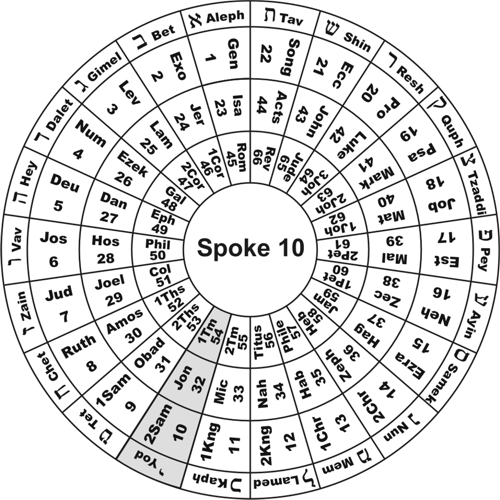
1 Timothy 2:8 (Spoke 10, Cycle 3)
The name of the Tenth Letter,  (Yod), comes from
the Hebrew word for a Hand, (Yod), comes from
the Hebrew word for a Hand,  (Yad).
This connection is
extremely well established in the Alphabetic Verses where Yad (Hand) appears
four times in the verses corresponding to Yod: (Yad).
This connection is
extremely well established in the Alphabetic Verses where Yad (Hand) appears
four times in the verses corresponding to Yod:
- AV Lam 1:10 The adversary hath spread out his hand upon all her pleasant things: for she hath seen that the heathen entered into her sanctuary, whom thou didst command that they should not enter into thy congregation.
- AV Lam 4:10 The hands of the pitiful women have sodden their own children: they were their meat in the destruction of the daughter of my people.
- AV Prov 31.19 She layeth her hands to the spindle, and her hands hold the distaff.
- AV Psa 119:73Thy hands have made me and fashioned me: give me understanding, that I may learn thy commandments.
This meaning of the tenth letter manifests in a number of significant ways in the
Book of 1 Timothy. It is the only book in the Bible to speak of "holy hands":
I will therefore that men pray every where,
lifting up holy hands, without wrath and doubting.
1 Timothy 2:8 (Spoke 10, Cycle 3)
This exemplifies the relation between the hand (yad) and the idea of praise expressed in the KeyWord
yadah. Paul amplified this theme in his reminder to Timothy of the gift he had received:
Neglect not the gift that is in thee, which was given thee by prophecy,
with the laying on of the hands of the presbytery.
1 Timothy 4:14 (Spoke 10, Cycle 3)
As far as I know, Timothy is the only person mentioned in all the Bible as receiving such a gift from the Apostle Paul by the laying on of hands.
Finally, Paul continues this theme in the only warning he gave on this topic in all
his writings:
Lay hands suddenly on no man, neither be partaker of other men's
sins: keep thyself pure.
1 Timothy 5:22 (Spoke 10, Cycle 3)
All of this is in perfect harmony with the meaning of the Letter governing Spoke 10.
The Role of Yod in Hebrew Grammar
The tenth letter, Yod, is a symbol of both
action and personal possession. This integrates with its
grammatical function in the Hebrew language as follows:
Action:
When Yod is prefixed to a triliteral root, the root is transformed into
the third person masculine imperfect tense, e.g. ברך (barak, to bless)
becomes יברך (yibrak) which
means "he blessed", "he blesses", or "he will bless" depending on context.
The fundamental idea is that the Yod signifies
his action. A similiar idea is seen in the etymology of the
English words such as manual and manipulate, which are based on the Latin word
for hand, manus.
Personal Possession:
When a noun is suffixed by a Yod, it the transforms the
noun into the first person possessive. For example, David
sang of the many things that God was to him:
My God (אלהי, Elohi) is
my rock (צורי, tsuri); in him will I trust:
he is my shield (מגני, Magni),
and the horn of my salvation (ישעי, yeshohi),
my high tower, (משגבי, mishgabi)
and my refuge (מנוסי, menosi),
my saviour (משעי, mishohi) ; thou savest me
from violence.
in 2 Samuel 22:3 (Spoke 10, Cycle 3)
In each of these cases, the noun was suffixed with
a Yod to signify the word my. Christians are familiar with this from the cry of
Christ when He was on the Cross - My God, My God (Elohi, Elohi). Thus we see that
the י (Yod, Hand)
means my or mine when suffixed to a word - it is the symbol
of that with which we grasp and possesse things.
This differs from the meaning of
Kaph (Palm of the Hand, or Open Hand) which
signifies the second person possessive, i.e. the idea that something is yours. This
is an astoundingly beautiful integrated symbolic system - the Active Hand (Yod) indicates
something is mine, whereas the Open Hand (Kaph - as if stretched
forth to offer you a chair)
indicates that something is yours. The difference between Yod and Kaph is discussed further
in Yod versus Kaph.
Our power to act is symbolized by the Tenth letter Yod. This integrates with the
Ten Commandments which teach us how to use this power. They are not to be understood
as merely warnings - they are also guides, as Paul wrote "the law is a schoolmaster
to guide us to Christ" (Galatians 3.24). The Ten Commandments integrate in a powerful way with the
content found in 1 Timothy on Spoke 10, Cycle 3.
| 

 Home
Home
 Holy Hands
 Printer Friendly Version