Amos: Fire on the Walls
Thus saith the LORD; For three transgressions of Gaza, and for four,
I will not turn away the punishment thereof; because they carried away captive the whole captivity,
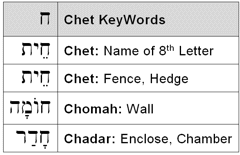
to deliver them up to Edom: But I will send a fire on the wall (chomah) of Gaza, which shall
devour the palaces thereof: And I will cut off the inhabitant from Ashdod, and him that holdeth the sceptre from Ashkelon,
and I will turn mine hand against Ekron: and the remnant of the Philistines shall perish, saith the Lord GOD.
Amos 1:6ff (Spoke 8, Cycle 2)
Like
the Book of Ruth, Amos begins in a rural agricultural setting.
The prophet was no city man, he eked out a living in the hinterland herding cattle and picking figs. In his words:
I was no prophet, neither was I a prophet’s son; but I was an herdsman, and a gatherer of sycomore fruit (figs).
And the LORD took me as I followed the flock, and the LORD said unto me, Go, prophesy unto my people Israel.
Amos 7:14f (Spoke 8, Cycle 2)
 God chose this farmer as the perfect "brush" to paint His message in agricultural metaphors.
Sin is likened to an overloaded cart "full of sheaves" (vs 2:13), the Israeli remnant as parts of a lamb the shepherd
retrieved from the mouth of a lion (vs 3:12), a harvest ruined for lack of rain (vs 4:7), and the people as
a basket of summer fruit (vs 8:1). Perhaps the most notable is God's promised redemption, which He said would burst
forth so miraculously that it would be as if "the plowman shall overtake the reaper, and the treader of grapes
him that soweth seed" (vs 9:13). The opening vision of Amos is different. Here God proclaims His judgment in terms of bringing
"fire on the walls" of three cities, Gaza (mentioned above), and Tyrus and Rabbah: God chose this farmer as the perfect "brush" to paint His message in agricultural metaphors.
Sin is likened to an overloaded cart "full of sheaves" (vs 2:13), the Israeli remnant as parts of a lamb the shepherd
retrieved from the mouth of a lion (vs 3:12), a harvest ruined for lack of rain (vs 4:7), and the people as
a basket of summer fruit (vs 8:1). Perhaps the most notable is God's promised redemption, which He said would burst
forth so miraculously that it would be as if "the plowman shall overtake the reaper, and the treader of grapes
him that soweth seed" (vs 9:13). The opening vision of Amos is different. Here God proclaims His judgment in terms of bringing
"fire on the walls" of three cities, Gaza (mentioned above), and Tyrus and Rabbah:
- Amos 1:10 But I will send a fire on the wall of Tyrus, which shall devour the palaces thereof.
- Amos 1:14 But I will kindle a fire in the wall of Rabbah, and it shall devour the palaces thereof,
with shouting in the day of battle, with a tempest in the day of the whirlwind:

Amos' vision of the Lord standing on a Wall
From the Bible Historiale (1372) |
God used this specific language only once outside the Book of Amos, in the vastly larger prophesy
of Jeremiah (vs 49:27). In the Minor Prophets it is unique to Amos, and it is based on
the fundamental Chet KeyWord chomah (wall) which exemplifies the primary significance of
Chet as the symbol of a hedge or fence. Furthermore, Amos contains nearly
half (four out of nine) occurrences of chomah found in the Minor Prophets. Yet this is but the beginning.
The Lord also gave Amos a vision based on this KeyWord that is seen nowhere else in the entire Bible, a vision of the
Lord Standing upon a Wall. (Note the tri-radiant halo in the artwork.)
The Chet Verse of AV Lamentations 2:8
The LORD hath purposed (chashav) to destroy the wall (chomah) of the daughter of Zion:
he hath stretched out a line, he hath not withdrawn his hand from destroying: therefore he
made the rampart and the wall (chomah) to lament; they languished together.
AV Lamentations 2:8
More than six months after writing the two articles about the emphasis on walls in Amos,
I reviewed the Chet Verse of AV Lamentations 2:8 and found to my surprise (and delight) that the
primary KeyWord at the beginning of the verse - chashav (to purpose) - is
followed by two occurrences of the secondary Chet KeyWord chomah (wall). This phenomenon of two KeyWords in
a single Alphabetic Verse is common, as seen, for example, in the Pey Alphabetic Verses.
The fact that I wrote the Synopsis of Spoke 8 in the Bible Wheel book without noting this extremely obvious correlation
only goes to show how huge the task really is. It also shows how the whole process of learning the Bible Wheel goes in
layered cycles. One first needs a basic overview to get the "big picture." This involves studying the whole Bible.
Then you go over it all again, and notice connections that you
couldn't see before. And then you do it all over again, now discovering many features to be obvious that were once invisible. And so it
goes as we dive ever deeper into the never-ending tapestry of Divine Wisdom that God has given us in His Holy Word.
|


 Home
Home
 Fire on the Walls
 Printer Friendly Version