How precious also are thy thoughts unto me, O God! how great is the sum of them! If I should count them, they are more in number than the sand:
Psalm 139.17f
Gematria - also known by its Greek name Isopsephia - is the study of the numerical relations implicit in the Greek and Hebrew languages. It is highly integrated with the study of the Wheel, and it played an essential role in the process God used to reval the divine structure of Scripture to me. Its many forms and nuances are discussed in the introductory articles such as Gematria and Scripture and Basic Greek - Gospel Light.
| Gematriot |
|
Standard (Std)
Sofit (Sof) R Class (RC) Full Ordinal (Ord) |
The five fundamental Gematriot (plural of Gematria) listed in the box to the right are explained below. Unless otherwise noted, all values listed in the Gematria Reference are derived from the Standard Values.
The full expression of the divine pattern of God's Word had to wait for a technology that could display linked ideas with great dexterity, which is the essence of idea of the hyperlink. The three Threads of the Bible Wheel site are inextricably interwoven. Throughout the articles on the Bible Wheel (Thread 1) and Inner Wheels and Cycles (Thread 2) there will be found hyperlinked numbers such as 13, 888, or 911 which link to articles discussing the said number. No matter where a given hyperlink is found on this site, it will always lead to the same article. This enforces an extreme degree of consistency to this presentation and avoids the charge of "you can do anything with numbers" with is one of the primary objections to the study of the alphanumeric structure of Scripture.
I currently have 18000+ alphanumeric identities recorded in my personal database, including the all the Greek and Hebrew words in Strong's Concordance. I began the process of moving them to this web site on October 1, 2001. I am constantly adding records. The current online database statistics are available on the Search GR page where all the identities may be viewed.
Standard Gematria Value
 Shekels with the numbers 2 and 4 written in the ancient alphabetic script.
The values shown in the Alphabet Table have been in use for at least two thousand years. They have been found on coins dating from the Maccabean period (first century) as shown in the image.
In my ten year study of the Hebrew and Greek alphabets, I have never seen a single scholarly challenge to the standard values given in the Table. The numeric weights of the letters are as well established as the letters themselves.
On the other hand, the question of the significance of the relations that emerge from the intrinsic alphanumeric structure of the Alphabets has never received widespread appreciation nor even recognition. It is my hope that this database will assist in the permanant alteration of this situation.
Sofit Value
Five Hebrew letters change form when written at the end
( , Sof) of a word. They are associated with these alternate
numeric weights, called Sofit values:
, Sof) of a word. They are associated with these alternate
numeric weights, called Sofit values:
| Kaph | Mem | Nun | Peh | Tsaddi |
 |
 |
 |
 |
 |
| 500 | 600 | 700 | 800 | 900 |
The most obvious example of the Biblical use of Sofit Values is seen in the Flood of Noah. The name of the Thirteenth letter, (Mem), signifies Mayim, Water. It is associated with two values - forty and six hundred. These numbers first occur in Scripture together and in conjunction with the Flood of Noah:
For yet seven days, and I will cause it to rain upon the earth forty
( ) days
and forty () nights; and every living
substance that I have made will I destroy
from off the face of the earth. And Noah did according unto all that the LORD
commanded him. And Noah was six hundred () years old when the flood of
waters was upon the earth.
) days
and forty () nights; and every living
substance that I have made will I destroy
from off the face of the earth. And Noah did according unto all that the LORD
commanded him. And Noah was six hundred () years old when the flood of
waters was upon the earth.
This is integrated with Spoke 13 in the article As the Waters Cover the Sea.
Another highly significant use of the Sofit Value, also involving the letter Mem, is found in the name of Abraham, the Father of the Faith (Rom 4.17). The Standard Value of his name is 248, which coincides with the value of Rahim (Mercy) and appears in the Rabinical Tradition that Abraham represents this attribute of God. Using the Sofit Value integrates Abraham's name with Christian Theology:
|
= 808 = |
|


With the addition of the five Sofit Values, the Alphabet is divided into two groups: one of 22 letters with Standard Values and one of 5 letters with Sofit Values. The 22 letters further subdivide into 3 "Mothers", 7 "Doubles", and 12 "Elementals". All these Numbers integrate with the structure of the Wheel in the following fundamental fashion:
| 3 | The Number of Cycles of the Wheel |
| 5 | The Number of Books in the Torah, Major Prophets, Wisdom, and NT History |
| 7 | The Number of Canonical Divisions on the Canon Wheel |
| 12 | The Number of Books in the OT History and Minor Prophets. |
| 22 | The Number of Books per Cycle, and the Number of Books in Cycle 3, the NT Epistles (Letters). |
Reduction Classes (Katan Value)
With the five alternate values, the alphanumeric structure of the Hebrew Alphabet becomes perfectly symmetric in a grid of 27 (= 3 x 9) letters:
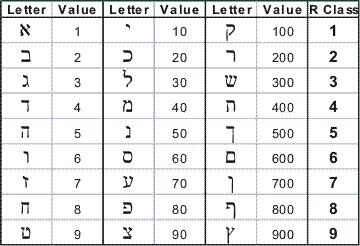
The letters in each row of this table are all members of the same Reduction Class, so called because the Standard Values are reduced to a single digit, the R-value, by adding the digits of its Base 10 representation.
The Rabinical Tradition refers to this as the Katan (small) Value. They also study the interchange of letters within the same Reduction Class to gain deeper insight into the divine design of the Hebrew Language.
Full Value
The Full Value of a word is calculated by replacing each letter of the word with its name, and summing the result. Rabinical Tradition refers to this as the (Milo, Full) spelling.
A prime example of this in the first word of the Hebrew Alphabet,
 (Av, Father). The Full Value of this word coincides
with the value of the phrase "Aleph and Tav."
(Av, Father). The Full Value of this word coincides
with the value of the phrase "Aleph and Tav."
|
= 523 = |
|


Aleph Beyt is the name of the Hebrew Alphabet which is spanned by "Aleph and Tav." These identities reveal the nature of God the Father, and the purpose of the Alphabet. This is further amplified by calculating the sum of the entire Hebrew Alphabet, which coincides exactly with the Greek phrase "The Everlasting God":
| Sum of the Hebrew | = 1495 = |
|

God designed the Hebrew and Greek Alphabets as an integrated system of self-revelation.
Ordinal Value
The Ordinal Value is determined by the letter's position
in the Alphabet. It is its place value. This view of the
Alphabet is closely aligned with the geometry of the Wheel. For
example, the Hebrew word for All, Whole, or Everything, is  (Kol). Its Ordinal
Value is 11 + 12 = 23. This coincides with the
Ordinal Value of Aleph + Tav, which is actually a manifestation of
the symmetric geometric correlation of these two words on the Wheel:
(Kol). Its Ordinal
Value is 11 + 12 = 23. This coincides with the
Ordinal Value of Aleph + Tav, which is actually a manifestation of
the symmetric geometric correlation of these two words on the Wheel:
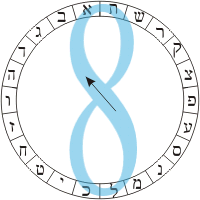
Another very significant application of the the Ordinal Value is found in the Hebrew word
 (Chokmah, Wisdom). The Standard Value of this word is 73 and the
Ordinal Value is 37. Both of these numbers are prime, and their product is the value of Genesis
1.1:
(Chokmah, Wisdom). The Standard Value of this word is 73 and the
Ordinal Value is 37. Both of these numbers are prime, and their product is the value of Genesis
1.1:
Sum of Genesis 1.1 = 2701 = 37 x 73
The number 2701 is the 73rd triangular Number.
|
Copyright notice.
|